How big is a red panda's home range?
A red panda's home range is smaller than many people expect for a wild carnivore, but it is not tiny. GPS collars fitted to red pandas in eastern Nepal put the median annual home range at 1.41 square kilometres, with some animals using less than half a square kilometre and others ranging past six. Males typically roam farther than females, and the shape of that space changes when forests shrink or roads cut through bamboo stands.
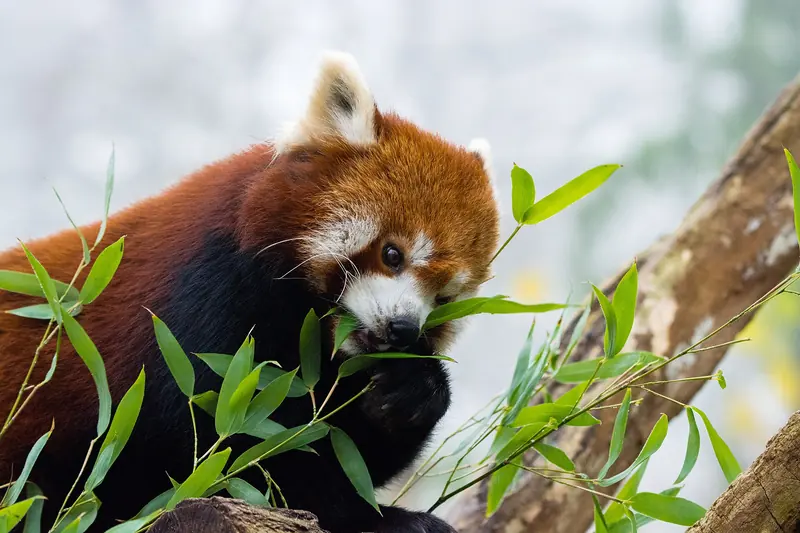
What a home range means for a solitary climber
A home range is the area an animal uses over a season or a year to feed, rest, mate and raise young. Red pandas are mostly solitary and spend much of their time in trees, so the map of their lives is a network of preferred bamboo patches, canopy and dens rather than a neat circle on the ground. For the basics of where they live and what they eat, see our red panda profile and panda habitat guide.
Until recently, most space use estimates for red pandas came from VHF radio tracking, which can miss long moves and understate range size. A 2022 paper in Endangered Species Research by Bista and colleagues switched to GPS telemetry, which records locations more often and with fewer missed fixes. That shift matters: for some other mountain carnivores, GPS work has produced ranges several times larger than older VHF numbers.
The GPS numbers: about 1.4 square kilometres
Bista, Baxter, Hudson, Lama, Weerman and Murray tracked red pandas with GPS and reported a median annual home range of 1.41 square kilometres (interquartile range about 0.63 to 2.79; overall span about 0.39 to 6.72). Nearly a quarter of that annual range was used as the core area, the zone the animal revisited most often.
Sex was the strongest predictor of home range size in their best fitting models. Males averaged about 1.73 square kilometres a year; females about 0.94. The authors argue that this pattern fits a polygynous mating system: males may overlap the ranges of several females, while females largely avoid sharing space with one another. Neighbouring males still overlapped almost half of their ranges. Outside the mating season, male and female pairs rarely met, which matches the picture of a mostly solitary lifestyle.
Seasons stretched those numbers further. Males expanded strongly in the birthing season. Females used relatively more space in the mating season and shrank to their smallest ranges while rearing cubs. Body mass and age helped explain core area size more than overall range size. The team also saw clear site fidelity: animals returned to favoured parts of their territory, with the strength of that habit varying by sex and season.
When roads and thin forest squeeze the map
Space is not fixed. In a related 2022 study in Landscape Ecology, the same research group (Bista, Baxter, Hudson, Lama and Murray) followed ten GPS collared red pandas for a year in eastern Nepal and scored disturbances with camera traps. Home range size rose where forest cover was scarce. Where road density was high, home ranges were smaller. Crossing rates suggested roads acted as barriers. Animals spent more time in large habitat patches and farther from roads and cattle stations, and they shifted their activity timing to reduce contact with people and livestock. For more on when red pandas are awake, read are red pandas nocturnal?
The authors warn that these trade offs may help red pandas cope in the short term but could hurt survival if fragmentation and forest use keep rising. That is why landscape scale planning, not only site level protection, matters for conservation; see our conservation overview.
Bamboo cover, not just forest on a map
Home range size answers how far an animal moves. Occupancy studies answer where the species still occurs. In 2017, Panthi, Khanal, Acharya, Aryal and Srivathsa surveyed Dhorpatan Hunting Reserve in Nepal with trail signs and hierarchical occupancy models. Overall occupancy was about 0.41, with high detectability. Bamboo cover predicted presence better than the share of forest cover alone. Bamboo extraction and livestock grazing both reduced occurrence, even when some bamboo remained.
Together the GPS and occupancy work say the same thing in different words: red pandas need connected bamboo rich forest, not simply a green polygon on a land cover map. Cutting bamboo or fragmenting canopy forces them into smaller or riskier space, which is the kind of pressure that keeps the species listed as endangered on the IUCN Red List.
How this compares with everyday scales
1.41 square kilometres is roughly 141 hectares, or about 350 acres. That is larger than many city parks and smaller than a big national park unit. It is also enough that a single road, cattle station or bamboo harvest plot can sit inside a panda's yearly map and change how it moves. Individual variation was high in the GPS sample, so any one animal may use much less or much more than the median.
If you want to see living red pandas in accredited collections, our where to see pandas list links each zoo to an official page. For how red pandas relate to giant pandas (they are not close kin), read are red pandas related to giant pandas?, and for coat colour science see why are red pandas red?.
Frequently asked questions
How big is a red panda's home range?
A 2022 GPS study in eastern Nepal found a median annual home range of 1.41 square kilometres, with individual ranges from about 0.4 to 6.7 square kilometres (Bista et al. 2022, Endangered Species Research).
Do male and female red pandas use the same amount of space?
No. In that study, males had a larger average annual home range (about 1.73 square kilometres) than females (about 0.94 square kilometres). The authors link the difference to a polygynous mating system, in which males may overlap several females.
What is a red panda's core area?
Nearly a quarter of the annual home range was used as the core area, the part of the territory the animal uses most intensively (Bista et al. 2022).
How do roads and forest loss change home range size?
In a companion GPS study, home ranges grew where forest cover was scarce and shrank where road density was high. Roads also acted as barriers to crossing, and pandas spent more time in large habitat patches away from roads and cattle stations (Bista et al. 2022, Landscape Ecology).
Why does bamboo cover matter more than total forest?
An occupancy study in Nepal's Dhorpatan Hunting Reserve found that bamboo cover predicted red panda presence better than overall forest cover, and that bamboo cutting and livestock grazing reduced occurrence even where bamboo remained (Panthi et al. 2017).
Sources
- Bista et al. (2022), Space use, interaction and recursion in a solitary specialized herbivore: a red panda case study, Endangered Species Research 47: 131 to 143. DOI 10.3354/esr01171
- Bista et al. (2022), Effect of disturbances and habitat fragmentation on an arboreal habitat specialist mammal using GPS telemetry: a case of the red panda, Landscape Ecology 37: 795 to 809. DOI 10.1007/s10980-021-01357-w
- Panthi et al. (2017), Large anthropogenic impacts on a charismatic small carnivore: Insights from distribution surveys of red panda Ailurus fulgens in Nepal, PLOS ONE. DOI 10.1371/journal.pone.0180978
- IUCN Red List: Red panda, Ailurus fulgens (2015 assessment)
- Smithsonian's National Zoo and Conservation Biology Institute: Red panda
Cite this page
APA
PandasWise. (2026, October 13). How big is a red panda's home range? https://pandaswise.com/blog/how-big-is-a-red-panda-home-range.html
MLA
"How big is a red panda's home range?" PandasWise, 13 Oct. 2026, https://pandaswise.com/blog/how-big-is-a-red-panda-home-range.html.
Chicago
PandasWise. "How big is a red panda's home range?" PandasWise. October 13, 2026. https://pandaswise.com/blog/how-big-is-a-red-panda-home-range.html.