Are red pandas nocturnal?
Red pandas are not truly nocturnal. They are mostly crepuscular, which means they are busiest around dawn and dusk, and they spend a little under half of each day awake. Field tracking in China found wild red pandas were actually more active in daylight than at night, while zoo studies show warm weather pushes them to rest more.
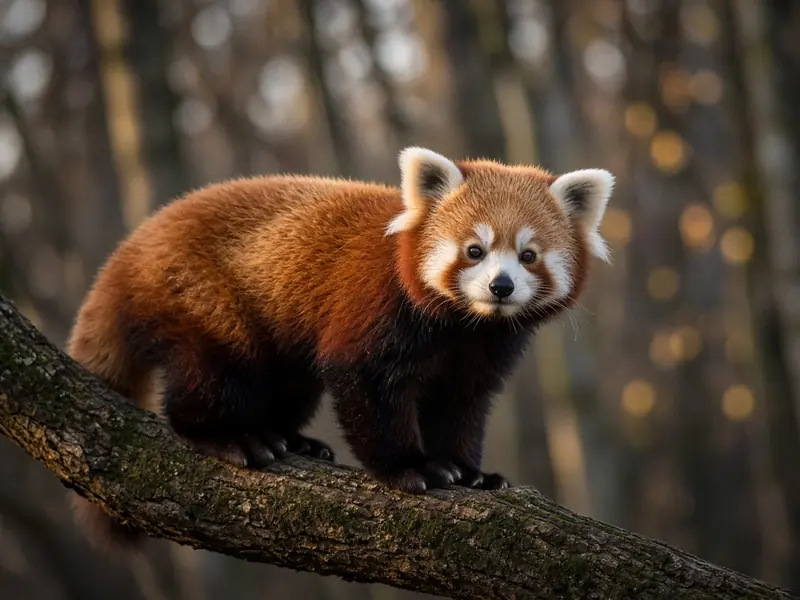
The short answer: dawn and dusk animals
Smithsonian's National Zoo describes red pandas in human care as able to be active at any time of day but primarily crepuscular, most active at dawn and dusk. On average they are awake for about 45 percent of the day, and they tend to be livelier in cooler weather, especially during the winter mating season. So if you have ever walked past a red panda exhibit at midday and seen nothing but a ball of red fur, that is normal behaviour, not a sign that the animal only comes out after dark.
What radio collars showed in the wild
The best known field study of wild red panda activity comes from the Wolong Reserve in Sichuan, China. David Reid, Hu Jinchu and Huang Yan radio tracked red pandas there and published their results in the Journal of Zoology in 1991. The collared animals were active 45 to 49 percent of the time, a figure that lines up closely with the zoo estimate.
Two other findings from Wolong stand out. First, activity was higher in daylight than at night, especially in summer, when the pandas were foraging up in the trees for fruit. Second, activity changed through the year: it peaked in April, and the radio collared female was especially busy in summer while she was nursing cubs. In other words, a red panda's schedule is shaped by what food is around and what its body needs that season, not by a fixed night shift.
The same study noticed something lovely about winter days. The pandas spent significantly more time resting on clear winter days than on overcast ones, which supports the idea that they bask in direct sunlight to save body heat. On a cold morning, lying still in the sun is a cheap way to stay warm.
What zoo cameras add: the midnight snack
A more recent study filled in the 24 hour picture. Kate Bugler, James Ross and Adrian Paterson used video cameras and in person observations to record the activity budgets of seven red pandas at three zoos in Australasia, published in Animals in 2023. The red pandas followed a crepuscular pattern, with a short extra peak of activity around midnight.
The strongest influence was air temperature. As temperatures rose, the red pandas gave more of their time to resting and sleeping. The authors describe their work as a preliminary study, with a small number of animals, but it fits neatly with the Smithsonian's observation that red pandas are more active in cool weather.
Why temperature matters so much
Red pandas are built for cold. They have dense fur that even covers the soles of their feet and a long bushy tail they wrap around themselves, which is ideal in a Himalayan winter but a burden on a warm afternoon. When it is hot they stretch out along branches and pant to lose heat.
Diet adds another constraint. Red pandas live mostly on bamboo leaves, a poor quality food. In Wolong, bamboo leaves turned up in 93.7 percent of 791 droppings examined. A diet like that leaves little spare energy, so it makes sense to rest through the warmest, least comfortable hours and save activity for the cooler edges of the day. Metabolism research has also shown that red pandas burn more energy at rest in winter than in summer (Fei and colleagues 2017, PLOS ONE), which helps explain why cold weather and activity go together. You can read more in our article on how red pandas stay warm.
Crepuscular, nocturnal and diurnal compared
- Nocturnal animals are active mainly at night. Red pandas are not in this group, although they can be awake for short spells after dark.
- Diurnal animals are active mainly in daytime. Wild red pandas in Wolong leaned this way, especially in summer.
- Crepuscular animals are most active in twilight around sunrise and sunset. This is the best single label for red pandas, according to both the Smithsonian and the Australasian zoo study.
Tips for seeing an active red panda
Visit early, ideally soon after the zoo opens, or late in the afternoon. Cool, overcast or crisp winter days are better than hot summer ones. Look up: red pandas spend a lot of time in trees, and a resting one often lies draped over a branch with its tail hanging down. Our guide to where to see pandas lists zoos that keep red pandas.
Key takeaways
- Red pandas are crepuscular, most active at dawn and dusk, not strictly nocturnal.
- They are awake for roughly 45 to 49 percent of the day, both in the wild and in zoos.
- Wild red pandas in Wolong were more active by day than by night, with activity peaking in April.
- Warm temperatures make red pandas rest more, and a short burst of activity around midnight has been recorded in zoos.
Frequently asked questions
Are red pandas nocturnal or diurnal?
Neither, strictly. Red pandas are best described as crepuscular, meaning most active around dawn and dusk. Smithsonian's National Zoo says red pandas in human care can be active at any time of day but are primarily crepuscular, and a radio tracking study in Wolong, China found wild red pandas were more active in daylight than at night (Reid, Hu and Huang 1991).
How many hours a day do red pandas sleep?
Red pandas spend a little under half the day awake. Smithsonian's National Zoo puts it at about 45 percent of the day, and radio collared red pandas in the Wolong Reserve were active 45 to 49 percent of the time. That leaves roughly 12 to 13 hours of rest and sleep in a typical day.
Why are red pandas most active at dawn and dusk?
Temperature is a big part of it. A study of seven red pandas at three zoos in Australia and New Zealand found they rested and slept more as the air got warmer (Bugler, Ross and Paterson 2023). Cool mornings and evenings suit an animal with a thick coat that is built for cold mountain forests.
Are red pandas active at night?
Sometimes. The same zoo study recorded a short extra burst of activity around midnight on top of the dawn and dusk peaks. In the wild, though, the Wolong red pandas were less active at night than during the day.
When is the best time to see a red panda at the zoo?
Early in the morning or late in the afternoon, and on cooler days. Red pandas tend to rest on hot afternoons, often stretched out on a branch.
Sources
- Reid, D. G., Hu, J. and Huang, Y. (1991), Ecology of the red panda Ailurus fulgens in the Wolong Reserve, China, Journal of Zoology 225(3): 347 to 364. DOI 10.1111/j.1469-7998.1991.tb03821.x
- Bugler, K., Ross, J. and Paterson, A. (2023), Activity patterns of captive red panda (Ailurus fulgens), Animals 13(5): 846. DOI 10.3390/ani13050846
- Smithsonian's National Zoo and Conservation Biology Institute: Red panda
- Fei, Y., Hou, R., Spotila, J. R., Paladino, F. V., Qi, D. and Zhang, Z. (2017), Metabolic rate of the red panda, Ailurus fulgens, a dietary bamboo specialist, PLOS ONE 12(3): e0173274. DOI 10.1371/journal.pone.0173274
- IUCN Red List: Red panda, Ailurus fulgens (2015 assessment)
Cite this page
APA
PandasWise. (2026, October 19). Are red pandas nocturnal? https://pandaswise.com/blog/are-red-pandas-nocturnal.html
MLA
"Are red pandas nocturnal?" PandasWise, 19 Oct. 2026, https://pandaswise.com/blog/are-red-pandas-nocturnal.html.
Chicago
PandasWise. "Are red pandas nocturnal?" PandasWise. October 19, 2026. https://pandaswise.com/blog/are-red-pandas-nocturnal.html.