How strong is a giant panda's bite?
A giant panda has one of the strongest bites of any bear once you account for its size. Its skull, jaw muscles and huge flat molars work like a nutcracker for bamboo, and research comparing every living bear species shows the panda is the only one with a jaw this specialised for heavy crushing.
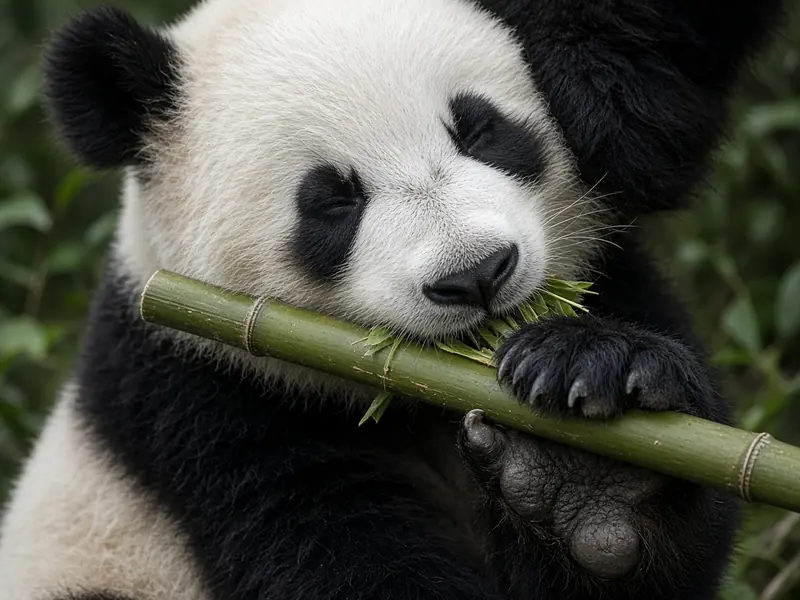
A bear that chews wood for a living
Bamboo is not soft food. Mature stalks are woody and full of tough fibre, and a giant panda may spend most of its waking hours eating them, as we explain in how much bamboo does a panda eat. To get at the nutrients, a panda grips the stalk with its false thumb, peels away the hard outer layer with its front teeth and then crushes the inner tissue with its back teeth. Smithsonian's National Zoo sums it up simply: giant pandas have large molar teeth and strong jaw muscles for crushing tough bamboo.
What the bear skull study found
In 2007 the Danish zoologist Per Christiansen published a study in the Journal of Zoology that estimated bite forces from 122 skulls covering all eight living bear species. Bite force can't easily be measured on a live wild bear, so he used a static model based on the shape of each dry skull, including where the jaw muscles attach and how far they sit from the jaw joint.
The giant panda stood out. Christiansen found that it has high bite forces for its body size and large moment arms around the jaw joint. In plain terms, its jaw muscles attach in positions that give them good leverage, a bit like holding a pair of pliers further from the hinge. That leverage applies to bites at the canine teeth and at the cheek teeth used for crushing.
He also concluded that the panda is the only bear that is truly specialised in its skull, teeth and bite forces. At the other extreme, the sloth bear, which eats mostly insects and fruit, has low bite forces, while polar bears and spectacled bears sit in the middle with fairly unspecialised skulls for their size.
Still not a perfect plant eater
One interesting twist in the same paper is that the giant panda, for all its power, is still not as specialised for plant eating as large herbivores such as deer or cattle. Christiansen suggested this may be because pandas have been eating bamboo for a relatively short time in evolutionary terms, or because their bear ancestry limits how far their skull can change. That fits the wider story told in our article on why pandas eat bamboo even though they are carnivores: a meat eater's body adapted, imperfectly, to a plant diet.
Bamboo eaters and bone crackers
A much broader study by Christiansen and the Australian palaeontologist Stephen Wroe, published in Ecology in 2007, predicted bite forces for 151 species across the whole order Carnivora. After adjusting for body size, two very different groups came out with high bite forces: animals that eat tough, fibrous plant material and predators that hunt large prey. Specialised insect eaters had the lowest.
A 2013 study in Evolution by Borja Figueirido, Zhijie Jack Tseng and Alberto Martin Serra looked at skull shape rather than force. Using measurements of living and extinct carnivores, they found that bamboo feeders and bone crackers such as hyenas share parts of the same skull shape space, a set of features linked to processing hard, tough food. Yet the lower jaw still reflects each animal's particular diet, bamboo or bone, and the two groups reached similar skulls by different evolutionary routes.
What gives the panda its bite
- A broad, heavy skull that gives large chewing muscles plenty of room to attach.
- Powerful jaw muscles with good leverage around the jaw joint (Christiansen 2007).
- Large, flat molars that grind and crush instead of slicing like a typical carnivore's teeth (Smithsonian).
Together these turn the panda into a very efficient bamboo crusher. They also mean a panda's bite deserves real respect. Smithsonian's National Zoo reminds visitors that giant pandas can be as dangerous as any other bear. For more on how the whole animal fits together, see our giant panda guide and the panda diet page.
Key takeaways
- For its body size, the giant panda has a high bite force, with strong leverage around the jaw joint (Christiansen 2007).
- It is the only living bear with a clearly specialised skull and bite, though it is still less specialised than large herbivores (Christiansen 2007).
- Across carnivores, eaters of tough plant material and hunters of large prey both have high bite forces for their size (Christiansen and Wroe 2007).
- Bamboo feeders and bone crackers share skull features for tough food, reached by different routes (Figueirido, Tseng and Martin Serra 2013).
Frequently asked questions
How strong is a giant panda's bite?
Very strong for an animal of its size. In a study of skulls from all eight living bear species, Per Christiansen (2007) found that the giant panda has high bite forces for its body size, along with long jaw lever arms that help it press hard on its back teeth.
Is a giant panda's bite stronger than other bears?
Relative to body size, yes. Christiansen's 2007 comparison of 122 bear skulls found the giant panda is the only bear whose skull and bite forces are clearly specialised, while the sloth bear sits at the opposite extreme with low bite forces suited to insects and fruit.
Why do giant pandas need such a strong bite?
Bamboo is tough and fibrous. A broad survey of 151 carnivore species by Christiansen and Wroe (2007) found that animals eating tough fibrous plant material have high bite forces for their size, much like hunters of large prey.
What teeth do giant pandas use to eat bamboo?
They peel stalks with their front teeth and then crush the woody tissue with large, broad molars. Smithsonian's National Zoo notes that giant pandas have large molar teeth and strong jaw muscles for crushing tough bamboo.
Can a giant panda bite be dangerous to people?
Yes. Smithsonian's National Zoo points out that giant pandas can be as dangerous as any other bear, and their powerful jaws are one reason. Wild or zoo pandas should never be approached.
Sources
- Christiansen, P. (2007), Evolutionary implications of bite mechanics and feeding ecology in bears, Journal of Zoology 272: 423 to 443. DOI 10.1111/j.1469-7998.2006.00286.x
- Christiansen, P. and Wroe, S. (2007), Bite forces and evolutionary adaptations to feeding ecology in carnivores, Ecology 88: 347 to 358. DOI 10.1890/0012-9658(2007)88[347:BFAEAT]2.0.CO;2
- Figueirido, B., Tseng, Z. J. and Martin Serra, A. (2013), Skull shape evolution in durophagous carnivorans, Evolution 67: 1975 to 1993. DOI 10.1111/evo.12059
- Smithsonian's National Zoo and Conservation Biology Institute: Giant panda
Cite this page
APA
PandasWise. (2026, October 23). How strong is a giant panda's bite? https://pandaswise.com/blog/how-strong-is-a-giant-panda-bite.html
MLA
"How strong is a giant panda's bite?" PandasWise, 23 Oct. 2026, https://pandaswise.com/blog/how-strong-is-a-giant-panda-bite.html.
Chicago
PandasWise. "How strong is a giant panda's bite?" PandasWise. October 23, 2026. https://pandaswise.com/blog/how-strong-is-a-giant-panda-bite.html.